

CRM Automations & Triggers
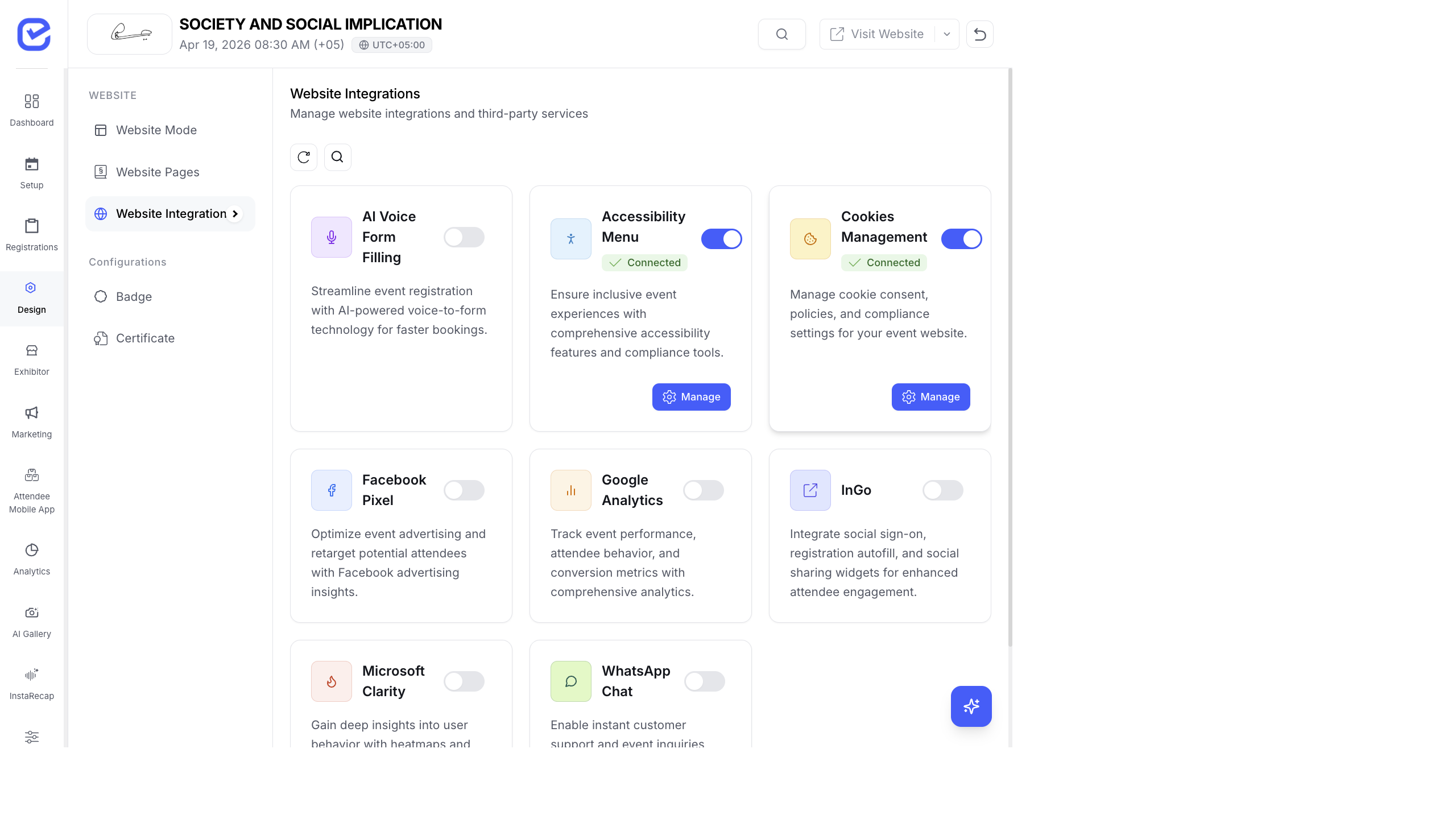
Automations let you trigger actions automatically when events happen — a new registration, a completed payment, a session starting, or a form submission.
How Automations Work
Section titled “How Automations Work”Each automation has two parts:
- Trigger — the event that fires the automation
- Action — what happens when the trigger fires
Available Triggers
Section titled “Available Triggers”| Trigger | When It Fires |
|---|---|
| New Registration | When an attendee completes registration |
| Session Starts | When a session’s start time is reached |
| Session Ends | When a session’s end time is reached |
| Form Submitted | When a custom form is submitted |
| Payment Completed | When a ticket payment is successfully processed |
Available Actions
Section titled “Available Actions”| Action | What It Does |
|---|---|
| Send Email | Send a templated email to the attendee or organizer |
| Send Notification | Send an in-app or push notification |
Email & Notification Templates
Section titled “Email & Notification Templates”Templates power automated communications. Each template has:
- Type — Email, Notification, or SMS
- Category — groups templates by purpose
Template Categories
Section titled “Template Categories”| Category | Use Case |
|---|---|
| Registration | Confirmation emails, welcome messages, ticket details |
| Sessions | Session reminders, schedule updates, speaker announcements |
| Feedback | Post-session surveys, event feedback requests |
| Reminders | Pre-event reminders, check-in instructions |
| Marketing | Promotional emails, early bird alerts, last-call notices |
Template Variables
Section titled “Template Variables”Templates support dynamic variables that are replaced with real data:
Hello {{attendee.name}},
Your registration for {{event.name}} is confirmed!Your ticket: {{ticket.name}}Event Date: {{event.date}}
Common variables: {{attendee.name}}, {{attendee.email}}, {{event.name}}, {{event.date}}, {{ticket.name}}, {{ticket.price}}, {{session.title}}.
HubSpot Sync
Section titled “HubSpot Sync”Sync registration data directly to HubSpot CRM.
- Open a ticket type’s settings.
- Enable Sync to HubSpot.
- When someone registers with that ticket, their data is automatically pushed to HubSpot as a contact with event context.
This is configured per ticket type — you can sync VIP registrations to HubSpot while keeping free ticket registrations local.
Setting Up an Automation
Section titled “Setting Up an Automation”- Go to Settings → Automations (or configure from the Marketing section).
- Select a Trigger (e.g., New Registration).
- Choose an Action (e.g., Send Email).
- Select or create an Email Template.
- Configure conditions (optional) — filter by ticket type, registration date, etc.
- Enable the automation.
- Test by creating a test registration and verifying the email sends.
Best Practices
Section titled “Best Practices”- Always send registration confirmations — this is the bare minimum automation. Attendees expect an immediate email confirming their registration.
- Schedule session reminders — send a reminder 1 hour before each session starts. This significantly improves session attendance.
- Use categories — organize templates by category to keep things manageable as your template library grows.
- Test every automation — create a test registration with your own email before going live. Verify the email content, template variables, and delivery.
- Don’t over-automate — sending too many emails annoys attendees. Limit automated emails to essential communications: confirmation, reminders, and feedback.